Aug 04, 2026
Timber Floors
KEY TAKEAWAYS
|
Perth averages 8.8 hours of sunshine a day, more than any other Australian capital, and that light lands directly on timber floors year-round.
Combined with the dust and grit that blow in from beaches and building sites, Perth homes put timber flooring through wear that homes in shadier, wetter cities rarely see, and colour is one of the biggest factors in how visible that wear becomes.
Homeowners choosing new flooring, or deciding whether to restain an existing floor, are often torn between the dramatic look of dark timber and the practicality of lighter tones.
The decision usually comes down to one practical question: which one actually hides scratches better day to day?
This guide covers a side-by-side comparison of light versus dark timber for scratch visibility, dust, sunlight exposure, and maintenance; the household factors, activity levels, pets, room orientation, that can shift the answer either way; guidance on species and finish selection; typical Perth costs; and answers to the questions homeowners ask most before making the call.
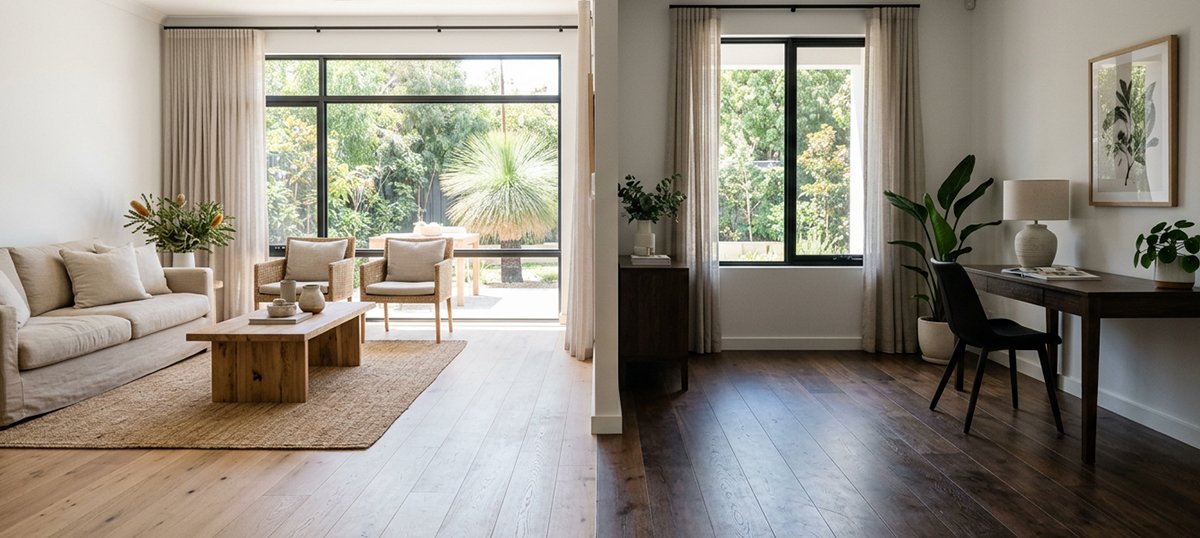
Light and mid-toned timber floors generally hide scratches better than dark timber floors in most Perth homes, and the gap widens in rooms that catch strong afternoon sun.
That's because a scratch exposes the timber's natural, lighter tone underneath the coating, so the contrast against a dark stain is far starker than the contrast against a pale or natural finish.
Dark floors aren't automatically off the table. A low-sheen, dark finish in a shaded, low-traffic room, in a household without large pets or young children, can hold up visually for years.
But if the priority is minimising visible wear with the least maintenance effort, particularly in a sun-facing living area, light and mid-toned timber is the lower-maintenance choice.
The comparison below breaks down why, and the sections after it cover the situations where that general rule bends.
| Factor | Light / Mid-Toned Floors | Dark Timber Floors |
| Scratch visibility | Exposed timber under a scratch is close in tone to the surface, so marks blend in | Exposed timber is lighter than the stain, so scratches read as pale lines |
| Dust, pet hair & footprints | Light dust and pale pet hair blend in; dark grit and mud stand out more | Dark dirt and mud blend in; dust and light-coloured pet hair stand out more |
| Perth sun exposure | Handles direct afternoon light with less glare and less contrast on marks | North- and west-facing rooms intensify contrast and highlight every mark |
| Maintenance frequency | Generally lower; everyday wear blends between cleans | Generally higher; needs more frequent dusting and mopping to look consistent |
| Best suited for | Busy households, pets, kids, sun-facing rooms, lower-maintenance preference | Shaded rooms, low-traffic formal spaces, households prioritising a dramatic look over low upkeep |
The table holds as a general rule, but species and grain pattern can shift it.
A dark board with heavy natural figuring, like a Jarrah with strong tonal movement, still disguises marks better than a flat, uniformly dark-stained board with minimal grain variation, because the eye reads variation in the grain as "normal" rather than damage.
A plain, evenly stained dark floor has nothing to camouflage a scratch against, which is why two dark floors in the same house can perform very differently depending on the board underneath the stain.
The comparison above is a general rule. These are the specific situations that push the decision one way or the other.
Every home experiences wear differently. Busy family households, large dogs, frequent entertaining, or regular furniture movement increase surface abrasion over time.
For high-traffic households, lean toward light or mid-toned floors, where minor scratches blend more naturally with surrounding grain. Reserve dark tones for lower-traffic, more formal spaces where marks accumulate slowly.
Spaces receiving intense afternoon sunlight highlight dust, fine scratches, and surface sheen. In these rooms, favour light or mid-toned boards with a matte or satin finish.
Rooms with limited direct sunlight show far fewer visual imperfections regardless of colour. In these settings, personal design preference can outweigh scratch-hiding performance, so a dark floor is a genuinely safe choice.
Claws, toys, chairs, and dropped objects create ongoing wear in households with pets or young children.
Textured finishes and lower-sheen coatings disguise minor imperfections more effectively than highly reflective surfaces, and grain variation helps camouflage light marks.
For these households, light or mid-toned timber with a matte finish is the more forgiving choice day to day.
Darker finishes need more frequent cleaning where dust, pet hair, or fine debris becomes visible quickly. Lighter tones disguise everyday particles more successfully between cleaning sessions.
If regular upkeep isn't a priority, light or mid-toned floors reduce how often the floor needs attention to look presentable.
For day-to-day care specifics, Allen Brothers Flooring's guide on How to Care for Floating Timber Floors in Perth Homes covers cleaning routines suited to Perth's climate.
Species selection influences durability, scratch visibility, and colour consistency.
While shade gets most of the attention, timber hardness plays an equally important role in resisting everyday wear, and natural grain variation within a species frequently helps disguise minor imperfections better than a uniform appearance.
Popular choices across Perth include Blackbutt, Spotted Gum, Karri, Jarrah, and Ironbark. Dense Australian hardwoods generally provide stronger resistance against dents and surface damage than softer alternatives.
Allen Brothers Flooring's guide on Ironbark vs Spotted Gum Flooring in Perth Homes compares two of the toughest options in more detail.
Coating selection directly affects how scratches, dust, footprints, and reflected light appear, often more than colour does on its own.
Lower-gloss finishes reduce reflections and help conceal fine surface marks. Busy households often favour this style for easier day-to-day presentation, regardless of colour.
Satin coatings balance visual richness and practicality. Moderate sheen enhances natural grain while avoiding excessive reflection.
Highly reflective coatings create a dramatic appearance, though scratches, dust, and cleaning marks become more noticeable under Perth's bright sunlight, on light and dark floors alike.
Brands frequently specified by flooring professionals include Bona, Loba, Osmo, Whittle Wax, and Polycure. Each product range offers different performance characteristics relating to sheen levels, wear resistance, curing times, and maintenance requirements.
Rather than selecting solely on price, compare expected traffic levels, desired appearance, and manufacturer support before making a final decision.
Reliable products start with reputable suppliers who provide clear specifications, warranties, and technical guidance.
Ask about species origin, request large physical samples viewed inside your own home rather than under showroom lighting, and confirm finish compatibility before purchase, since not every coating performs equally well on every species.
Experienced specialists can identify suitable combinations based on household needs, sunlight exposure, pets, and maintenance expectations.
Homeowners considering restoration rather than replacement may also benefit from exploring professional Floor Polishing services to maximise value from existing surfaces.
Expenses vary according to species selection, room size, subfloor condition, finish requirements, access complexity, and whether existing surfaces require restoration or replacement.
Colour choice itself doesn't change the base price, but darker floors that need more frequent professional cleaning or recoating can cost more to maintain over time.
Indicative Perth pricing ranges are outlined below.
| Project Component | Typical Cost Range (AUD) |
| Basic engineered boards supplied and installed | $80–$140 per m² |
| Premium hardwood supplied and installed | $140–$250+ per m² |
| Sanding and refinishing existing surfaces | $35–$70 per m² |
| Premium coating application | $15–$40 per m² |
| Furniture removal and site preparation | $200–$1,000+ |
| Repairs to damaged sections | $100–$1,000+ depending on extent |
Figures represent general market estimates and may vary according to site conditions, material availability, project scope, and specification requirements. Confirm current pricing with Allen Brothers Flooring for an accurate onsite quote.
Comparing itemised proposals allows a clearer understanding of material specifications, preparation requirements, warranties, and labour inclusions.
Reserve an additional 10–15% of your budget for unexpected discoveries such as moisture issues, hidden damage, or repair requirements. This is a standard contingency margin used across most home renovation trades, not just flooring.
Existing surfaces may respond well to sanding, repairs, and recoating.
In many situations, refurbishment costs substantially less than complete replacement while still delivering a dramatic visual improvement, and it's a chance to move to a lighter tone if scratch visibility is the deciding factor.
To bring it back to the original question: light and mid-toned timber floors are the stronger choice for hiding scratches in most Perth homes, especially in bright, high-traffic rooms.
Dark floors remain a valid choice for shaded, lower-traffic spaces, or for households prepared for more frequent cleaning and a matte finish to manage the sunlight.
Key factors behind that answer:
Allen Brothers Flooring has spent more than 30 years helping Perth homeowners protect, restore, and enhance timber surfaces through meticulous workmanship and premium coating systems. As a licensed and insured family-owned business, our reputation has been built through long-term relationships, with many clients returning repeatedly over the years because they trust our commitment to craftsmanship. Every property is different, and the fastest way to know which option suits yours is to see samples under your own lighting, which is exactly what our free consultation is for.
If you're still unsure which option will best hide scratches in your Perth home, book Allen Brothers Flooring's free timber flooring consultation, valued at $195, and get personalised advice based on your property, lifestyle, and design goals.
Whether you're considering floor restoration, sanding, polishing, or a complete flooring upgrade, we are here to help you avoid costly mistakes and achieve a result you will enjoy for years to come.
Contact Allen Brothers Flooring today to arrange your free timber flooring consultation and onsite quote. Our experienced team will assess your floors, answer your questions, and recommend the most suitable solution for your home and budget.
For most Perth homes, light or mid-toned timber with a matte or satin finish hides scratches best, particularly in sun-facing living areas.
Choose dark timber for shaded, lower-traffic rooms where the dramatic look matters more than low-maintenance scratch concealment.
Generally, yes. Because a scratch exposes the timber's natural, lighter tone underneath the stain, the contrast is more visible on dark boards.
Light or unstained floors show far less contrast when the same scratch occurs, though grain pattern and sheen level still play a large role.
Rooms that face north or west and receive strong afternoon sun tend to show every mark on high-gloss, dark-stained boards.
A satin or matte finish in a lighter or mid-toned timber generally holds up better under Perth's sunshine hours than a highly reflective dark floor.
Yes. Matte and low-sheen coatings scatter light rather than reflecting it directly, which makes fine surface marks and dust considerably less noticeable than they appear under a high-gloss finish, regardless of colour.
In most cases, yes. Sanding and refinishing an existing floor typically costs a fraction of full replacement, provided the boards are structurally sound and not damaged beyond what sanding can remove.