Apr 20, 2026
Timber Floors
Key Takeaways
|
Morning sunlight on a timber floor is a hallmark of Perth home design, but the sun is notoriously hard on natural wood.
In a climate defined by bone-dry 40°C summers and humid coastal winters, your choice between engineered and solid timber determines whether your floor remains flawless or begins to cup, gap, and creak within a few seasons.
While both offer the warmth of real hardwood, they handle Western Australia’s environmental stress differently:
Choosing the right board involves balancing aesthetic tradition with structural resilience.
In this guide, we analyse how both constructions perform against Perth’s unique temperature cycles, moisture levels, and installation requirements to help you secure a floor that thrives for decades.
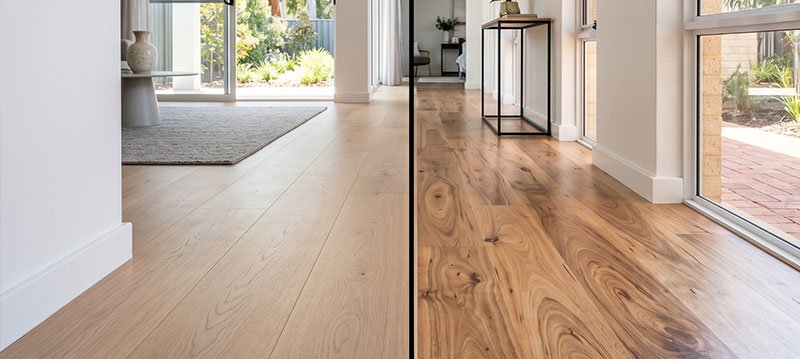
Engineered timber flooring uses a genuine hardwood surface layer bonded over multiple stabilising layers beneath.
Construction method improves dimensional stability, making this alternative increasingly popular in modern Perth homes where seasonal humidity and heat fluctuations influence building materials.
Solid timber flooring consists of boards milled from single hardwood pieces, delivering traditional character valued in heritage homes and premium residential builds.
Perth homeowners often select this classic material for long-term durability and the ability to refinish floors repeatedly across decades.
| Factor | Engineered Timber Flooring | Solid Timber Flooring |
| Structural Stability | Multi-layer core improves resistance to expansion and contraction | Natural timber movement increases with humidity changes |
| Installation | Often suitable for floating or glue-down systems | Usually requires nail-down or direct fixing |
| Longevity | Long lifespan with correct maintenance | Exceptional lifespan when refinished multiple times |
| Climate Adaptability | Performs well in fluctuating humidity environments | Better suited to stable indoor conditions |
| Refinishing Potential | Limited sanding cycles due to veneer thickness | Can be sanded and refinished many times |
| Cost Range | Generally moderate, depending on timber species | Higher upfront cost for premium hardwood boards |
| Environmental Impact | Efficient use of timber resources | Uses larger quantities of hardwood material |
Engineered timber offers strong performance where temperature swings occur between summer heat and cooler winter evenings. Layered construction reduces movement because cross-directional plywood or composite layers stabilise the surface veneer.
Perth homes near the coast—such as properties in Fremantle or Hillarys—often benefit from this improved dimensional stability when humidity shifts.
In contrast, the traditional hardwood structure reacts more noticeably to environmental changes. Natural fibres absorb and release moisture according to seasonal conditions. Expansion gaps around room edges allow boards to move safely, yet careful climate control remains important for maintaining long-term performance.
The layered construction usually provides a cost-efficient entry point while still delivering an authentic hardwood appearance. Many homeowners find engineered timber offers a strong balance between visual appeal and budget management.
Traditional planks typically involve higher upfront expenditure due to thicker hardwood material and specialised installation methods. Long-term value may offset initial cost because repeated sanding allows restoration rather than replacement across decades.
Layered boards provide excellent resistance to everyday wear when coated with premium finishes such as Bona or Osmo products, frequently used by experienced floor restoration specialists. Stability also helps prevent gaps or cupping when Perth experiences sharp seasonal dryness.
The solid hardwood structure delivers exceptional longevity when maintained correctly. Several sanding cycles allow renewal across generations, making this choice popular among homeowners restoring heritage properties or character homes throughout Western Australia.
Layered boards allow wider planks and consistent grain patterns due to modern manufacturing techniques. Design flexibility suits contemporary interiors where larger boards create spacious visual flow.
Traditional hardwood boards offer unique natural grain variation and authentic character formed by each tree’s growth pattern. Many homeowners appreciate this organic variation, particularly within classic architectural styles common across older Perth suburbs.
Layered timber construction uses hardwood veneer more efficiently because structural layers rely on plantation-grown or engineered materials. Efficient resource use can reduce demand for slow-growing hardwood species.
Conversely, traditional hardwood boards use larger volumes of solid timber. Responsible sourcing from certified forestry programs helps maintain ecological balance, yet the environmental footprint depends heavily on supplier practices and timber species selection.
Multi-layer boards often support floating installation systems, allowing quicker fitting above concrete slabs commonly found in Perth homes. This approach can reduce installation disruption during renovation projects.
By comparison, solid hardwood usually requires nail-down installation over timber subfloors. Preparation takes longer, though many flooring specialists appreciate the structural integrity provided by traditional fixing techniques.
Evaluation across climate stability, longevity, design preferences, and environmental considerations helps homeowners determine which flooring construction suits their Perth property.
Many modern apartments in suburbs such as Subiaco, Scarborough, or South Perth rely on slab construction, which can create minor moisture fluctuations and temperature shifts across seasons.
In such environments, engineered timber flooring often provides greater stability because layered construction resists expansion caused by humidity changes.
Floating installation methods also allow efficient fitting above concrete bases without complex structural work. This setup suits renovation projects where homeowners want a natural timber appearance without extensive rebuilding.
Solid hardwood boards may still be installed in these settings, although specialist preparation usually becomes necessary.
Direct fixing systems or moisture barriers increase complexity, meaning installation tends to suit projects where structural adjustments are already planned.
Modern Perth homes increasingly feature wide living zones that connect kitchen, dining, and lounge spaces into one continuous layout. Large rooms allow natural light to highlight floor surfaces, making material movement more noticeable across seasons.
Traditional solid timber flooring often performs well across expansive interiors when installed over stable subfloors. Thick boards provide long-term durability while allowing refinishing throughout decades of use.
Heritage houses in suburbs such as Mount Lawley or Nedlands frequently benefit from this construction, particularly where existing timber framing supports direct fixing methods.
By contrast, layered boards can also perform effectively in open-plan designs when dimensional stability becomes a concern. Wider plank formats produced through engineered manufacturing help maintain visual continuity across broad spaces.
Perth’s coastline stretches more than 120 kilometres, exposing many properties to salty air, sea breezes, and elevated humidity levels.
Suburbs such as Cottesloe, Hillarys, and Rockingham experience noticeable moisture fluctuations, particularly during winter.
In these conditions, engineered timber flooring generally adapts better because cross-layer construction reduces expansion and contraction.
Stability helps maintain tighter joints between boards even when environmental moisture varies throughout the year.
Traditional hardwood boards can still perform successfully near the coast, though careful climate control and proper installation gaps become essential.
Older Perth houses—especially Federation or mid-century properties—often feature timber joist subfloors beneath existing flooring. Restoration projects frequently aim to preserve architectural character while upgrading durability.
Within these homes, solid timber flooring tends to align well with structural design because boards can be nailed directly to timber framing. Long-term refinishing potential also suits heritage restoration, allowing floors to evolve alongside property renovations.
Layered boards remain an alternative where height limitations or structural changes require floating installation. Renovators sometimes choose this option when maintaining existing subfloor structures proves impractical.
Although less common in Western Australia compared with colder regions, underfloor heating systems are gradually appearing in premium Perth renovations.
Heating introduces temperature changes beneath floorboards, requiring materials that handle expansion safely.
Engineered timber flooring often performs more consistently in heated systems because layered construction reduces stress caused by repeated warming cycles. Stability prevents excessive movement across seasonal temperature shifts.
Solid hardwood boards can operate above heated systems in some cases, although careful species selection and moisture control become essential to minimise movement over time.
Different installation scenarios create different priorities. Apartments, coastal homes, large living zones, and heritage renovations each present unique environmental conditions.
Choosing between engineered and solid timber is about matching a board's structure to your home's specific environment.
In a city where coastal humidity meets inland heat, the best floor is the one that stays stable under your feet.
Ultimately, your subfloor type and lifestyle will dictate the right choice. By balancing structural resilience with natural aesthetic, you can ensure your timber floor remains a high-value asset for decades.
At Allen Brothers Flooring, we apply over 30 years of Perth craftsmanship to every surface we touch. We understand how Western Australia’s unique climate treats timber, ensuring your floors are installed and finished to withstand decades of heat and humidity.
From precision installation to expert restoration, our reputation is built on the details that matter. We take the guesswork out of your renovation, providing the technical insight needed to avoid costly mistakes and ensure a flawless finish.
Ready to transform your home? We offer a free onsite timber flooring consultation (valued at $195) to provide expert guidance tailored to your space.
Written by Chris Allen, co-founder, Allen Brothers Flooring