Mar 12, 2026
Timber Floors
Key Takeaways:
|
Salt air and coastal humidity don’t stay at the beach. They follow you home, quietly affecting every material inside.
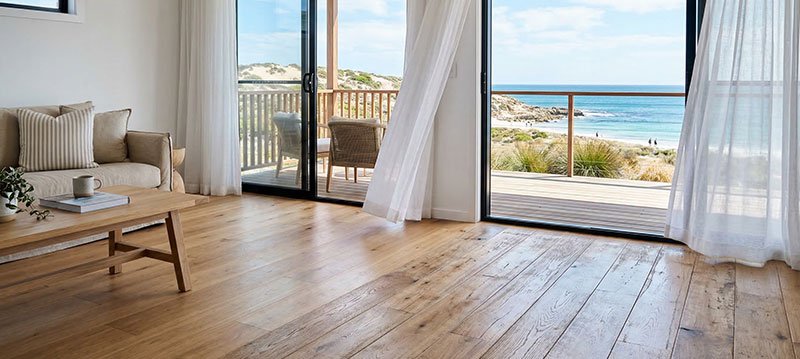
For Perth homeowners, timber flooring is the ultimate choice for warmth and character, but the coastal strip introduces a unique set of challenges. Between shifting moisture levels and intense UV exposure, a floor that works in the Hills might struggle in Cottesloe or Scarborough.
Understanding how natural wood reacts to the shoreline environment is the difference between a floor that ages beautifully and one that buckles under pressure.
In this guide, we break down the realities of coastal timber so you can move past generic advice and choose a timber solution engineered for the longevity and lifestyle demands of a Perth beach house.
|
In Perth’s coastal suburbs, timber flooring offers a rare blend of organic warmth and structural resilience, provided the species and format are matched to the salt and humidity of the shoreline.
Here is how different timber solutions perform in a coastal environment:
Engineered Timber (The Coastal Specialist): This is often the premier choice for modern beachside homes. Its layered construction is specifically engineered to resist the "cupping" and "gaping" caused by Perth’s fluctuating humidity.
Solid Hardwood (The Heritage Standard): Ideal for long-term renovations where you want the ability to sand and refinish the floor multiple times over many decades.
Natural Insulation: Unlike cold tiles, timber provides excellent thermal comfort, keeping your home cooler in the summer and warmer during those brisk coastal winters.
Refinishing Potential: Unlike laminate or vinyl, quality timber can be repaired and refreshed without requiring a full replacement, significantly increasing your home's resale value.
Success in a seaside home depends on more than just aesthetics. To ensure your floors last, we focus on:
UV Protection: Using specialized coatings for north-facing glass to prevent the intense WA sun from fading your floor's natural color.
Moisture Barriers: Ensuring slabs are correctly sealed to prevent moisture ingress from the coast's high water tables.
Strategic Placement: While timber is stunning in living areas, we recommend alternative materials or enhanced protective seals for high-moisture zones like laundries and entries.
Moisture sits at the centre of performance. Coastal air carries higher humidity levels, while salt particles settle invisibly across surfaces. Properly specified boards tolerate these factors well, provided movement allowances, acclimatisation periods, plus sealing protocols receive correct attention.
When weighing construction types, we recommend comparing performance differences between engineered, laminate, and solid wood flooring in real-world applications before selecting materials for coastal properties.
| Condition / Variable | Performs Well | Requires Extra Control |
| High humidity zones | Engineered boards | Solid planks |
| Salt exposure areas | Factory-sealed surfaces | Oil-finished surfaces |
| North-facing rooms | UV-resistant coatings | Natural oils |
| Slab-on-ground homes | Floating or glued systems | Direct nail-down |
| Heavy family traffic | Matte polyurethane finishes | Soft wax finishes |
Boards installed with acclimatisation periods under 72 hours experience noticeably higher movement rates during the first summer cycle.
Professional assessment before commitment remains critical. Engaging experienced trades ensures site-specific recommendations guide decisions rather than generic assumptions. One well-planned installation avoids costly remediation, delivering durability even under coastal pressures.
Long-term performance also depends on correct restoration cycles, which is why understanding how professional floor sanding extends timber lifespan becomes especially important in high-salt environments.
Every successful coastal installation starts with a clear read of local conditions. Distance from shoreline, prevailing winds, elevation, plus ventilation patterns influence moisture behaviour inside homes.
Properties west of Marmion Avenue often experience higher salt exposure than inland suburbs, which changes coating recommendations and maintenance planning. Slab moisture testing or subfloor airflow checks help avoid movement issues later.
Air conditioning use, ceiling heights, plus window orientation affect internal humidity swings. Homes with large west-facing glazing experience stronger temperature variation, increasing expansion risk without proper allowances.
Board width, thickness, plus construction type matter more in near-ocean environments. Wider planks move more during seasonal change, making engineered formats preferable for many coastal properties. Thicker wear layers support refinishing cycles, extending service life without compromising stability.
Dense Australian hardwoods perform well when sealed correctly, while softer imported species require stricter climate control. Selection should reflect lifestyle demands rather than appearance alone.
Concrete slabs require moisture testing before installation begins. Raised homes need clear airflow pathways beneath flooring systems to prevent trapped dampness. Vapour barriers, levelling compounds, plus correct fixings reduce long-term stress on boards.
Floating systems suit apartments or slabs with variable moisture. Glue-down approaches offer stability when substrates meet moisture thresholds. Nail-down installations demand careful spacing plus consistent subfloor conditions.
Finish choice directly influences coastal performance. Hardwearing coatings protect against salt abrasion, while natural oils suit owners prepared for regular upkeep. UV resistance becomes critical in sun-exposed living zones to limit colour shift.
Rushing boards straight from delivery into fixing remains one of the most frequent issues we fix. Coastal humidity demands extra adjustment time before installation begins. Without proper acclimatisation, expansion shows up weeks later as cupping, gapping, or edge lift.
Materials arrive, schedules feel tight, and installation starts immediately. Seasonal moisture then finds its way into boards unevenly, creating movement that no finish can hide.
Assuming every timber option behaves the same near oceanfront homes causes avoidable failures. Certain species, constructions, plus finishes tolerate salt-laden air far better than others.
Aesthetic choices override performance needs. Homes near open coastlines require stability-first selections rather than showroom favourites.
Moisture testing often gets skipped, especially during renovations. Subfloors beneath raised homes also get overlooked, trapping damp air below boards.
Hidden moisture leads to mould risk, adhesive failure, plus premature wear. Rectification usually costs far more than proper assessment upfront.
Wider planks look stunning yet demand precise spacing allowances. Insufficient perimeter gaps restrict natural movement, forcing boards to push against walls or fixtures.
Problems surface once summer arrives, not during installation. Repairs then involve cutting edges or full refits.
Installation guides exist for good reason, though many projects ignore recommended adhesives, fixing patterns, or curing times.
When weighing professional installation against DIY, coastal conditions magnify small mistakes. Moisture testing, expansion allowances, plus correct finish selection require expertise.
Homeowners considering self-installation should first understand common risks outlined in the comparison between DIY floor sanding and professional workmanship, particularly where coastal humidity adds complexity.
When coastal homeowners compare materials, performance differences appear quickly once moisture, salt, plus wear enter daily life.
| Consideration | Timber Flooring | Hybrid / Laminate Options |
| Natural appearance | Authentic grain, warmth | Printed surface |
| Repair potential | Sanding, refinishing possible | Replacement required |
| Coastal longevity | Strong with correct prep | Moderate, moisture-sensitive |
| Underfoot comfort | Warm, quiet | Harder feel |
| Long-term value | High resale appeal | Limited uplift |
Hybrid products suit short-term budgets or low-impact areas. Timber solutions reward owners seeking longevity plus character when installed correctly.
Installation method shapes outcome more than product choice alone, particularly within coastal zones.
Professional installation
Accurate moisture testing
Correct acclimatisation periods
Warranty-backed workmanship
Site-specific material selection
DIY installation
Limited moisture assessment
Higher risk of spacing errors
No workmanship warranty
Increased likelihood of rework
Board construction influences seasonal movement, especially where humidity fluctuates.
Solid boards
Thick wear layer
Refinishing flexibility
Requires stable internal conditions
Engineered boards
Layered core improves stability
Better humidity tolerance
Ideal for coastal slabs or apartments
Salt air, humidity swings, and sun exposure all influence the lifespan of your timber flooring.
Remember:
Coastal performance depends on board construction, finish selection, plus moisture control
Engineered options often provide added stability near shoreline environments
Correct acclimatisation, spacing, plus subfloor preparation prevent movement issues
Protective coatings reduce wear from salt, sand, plus UV exposure
Professional assessment avoids costly mistakes seen after rushed installs
Speaking with an experienced specialist before committing allows tailored recommendations, clearer budgets, plus long-term confidence rather than assumptions. Taking expert advice now saves repairs later and keeps coastal interiors looking their best for years ahead.
In Perth’s shoreline suburbs, subtle factors like humidity fluctuations, finish compatibility, and installation timing are the difference between a floor that lasts decades and one that wears prematurely.
At Allen Brothers Flooring, we bring over 30 years of specialized experience to every project. We don’t rely on generic assumptions; our recommendations are grounded in real-world performance across Western Australia’s unique climate.
By combining premium materials with meticulous installation techniques, we protect your investment and your peace of mind from day one.
Ready to choose a floor that can actually handle the coast? Reach out to the Allen Brothers team today for personalised advice or a detailed on-site quote.
Written by Chris Allen, co-founder, Allen Brothers Flooring